Industrial research PROJECT
Controller working position/Human machine interface - CWP/HMI
Controller working position/Human machine interface - CWP/HMI
The project aimed to reduce development and operating costs of air navigation service provision. These savings ultimately benefit airlines and their customers. It achieved this by delivering the ATM Master Plan goals (defined by the European ATM community) for a more efficient deployment of human resources, a progressive increase in automation support, the implementation of virtualisation technologies and the use of standardised and interoperable systems whilst increasing the safety level.
The project delivered two innovative solutions:
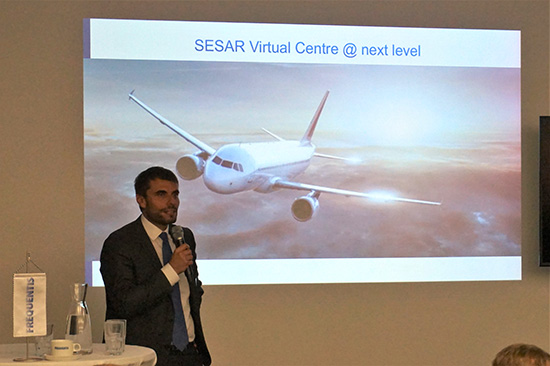
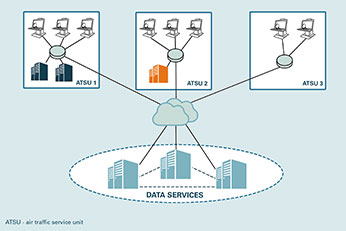
Workstation, service interface definition & virtual centre (PJ.16-03) is a concept for separating the controller working position (CWP) from the datacentre where the data is produced. This lean and efficient use of ANSP infrastructure tackles the issues presented by fragmented European ATM systems and country-specific architectures, enabling Europe to move to an interoperable, cost effective and flexible service provision infrastructure. Decoupling of the CWPs should enable a more efficient use of the most valuable and expensive resource, the human. By enabling increased flexibility the ANSPs should better manage staffing for prevailing traffic conditions and assure service continuity.
Workstation, controller productivity (PJ.16-04) refers with new methods of controller interaction with the human machine interface (HMI), applying mature technologies from other domains to ATM. This increased controller productivity, reduce workload, stress level and enable the use of SESAR advanced tools, safely facilitating performance based operations.
Furthermore, the use of modern thin client technology and the processes for developing HMI solutions are investigated, aiming at more efficient CWP development and operation. The solution has several features:
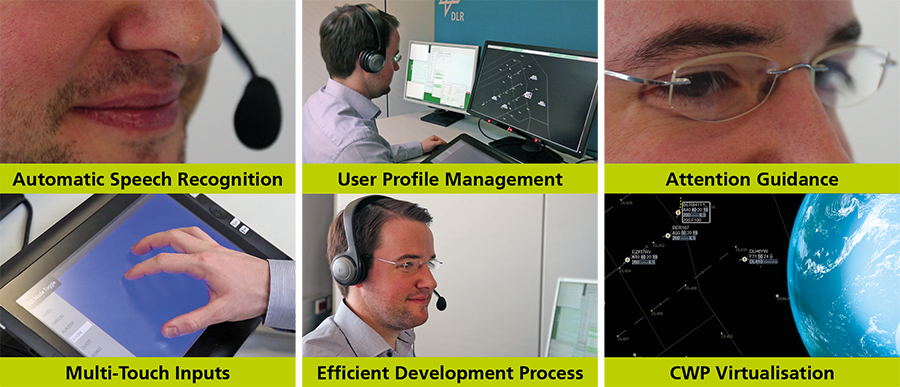
- Multi touch inputs are made possible thanks to a trackpad or touchscreen and a virtual keyboard. This new HMI interface allows controllers to make data inputs into the system more efficiently and without increasing the failure rate.
- An automatic speech recognition (ASR) system takes audio signals and transforms them into a sequence of words, i.e. “speech-to-text” following the recognition process. The resulting concepts can be used for further applications such as visualization on an HMI.
- With attention guidance, a controller’s visual or mental focus is actively directed to a specific spot of the CWP HMI if necessary. The specific spot is an area where the controller should look at to determine an assistance system (e.g. because of a potential conflict, long absence of attention, or demanded actions). The necessity to look at this spot is given if the controller did not look there for a certain amount of time (e.g. determined by an eye-tracking system).
- User profile management systems are a key enabler for automated HMI customisation through user authentication, application of ID cards or biometric technology. Once the controller is identified in a safe and secure manner, his/her predefined profile related to a particular role or a task on the CWP recognised and the HMI settings will be customised to this profile. This can happen during a shift change or whenever a controller’s task or role on the CWP changes, for instance in the case of a change of sectorisation.
- Agile-style processes aim to provide a better description of controller needs at an earlier stage of the project life cycle, with higher fidelity and greater user buy-in than traditional “waterfall” development methodologies.
- CWP virtualisation changed the way controllers interact with the system. In doing so, this will require controller training and appropriate qualifications to handle the applications underpinning the CWP.
Download the full report on PJ.16-04 providing a detailed overview of the activities performed in the frame of the PJ16.04 CWP-HMI Solution




This project has received funding from the SESAR Joint Undertaking under the European Union's Horizon 2020 research and innovation programme under grant agreement No: 734141

Project ID:
PJ16 CWP HMI
Grant ID:
734141
Status:
Completed
Project duration:
01-11-2016 > 31-12-2019
EU contr.:
€ 12.628.761,69
Total cost:
€ 21.252.138,10
Activity:
Industrial research
Flagship:
Not applicable
SESAR programme:
SESAR 2020
Benefits:
Cost efficiency
Participants:
Thales, Rizeni Letoveho Provozu Ceske Republiky Statni Podnik (Air Navigation Services of the Czech Republic), Letove prevadzkove, Austro Control, Hrvatska Kontrola Zracne Plovidbe (Croatia Control), AirNav Ireland, Luftfartsverket (LFV), Naviair, DFS Deutsche Flugsicherung, Direction Des Services De La Navigation Aerienne (DSNA), ENAIRE, ENAV, NATS, Skyguide, Eurocontrol, Deutsches Zentrum für Luft- und Raumfahrt (DLR), Frequentis, HungaroControl, Leonardo, Oro Navigacija, PANSA (Polska Agencja Żeglugi Powietrznej), Stichting Koninklijk Nederlands Lucht - En Ruimtevaartcentrum (NLR), Eviden, Airtel ATN, SAAB, Sintef
Controller working position/Human machine interface - CWP/HMI