
An Interview with Martin Gerber, co-founder and director of the Swiss SkyLab Foundation
Reducing aviation's environmental footprint remains a key industry objective, but is particularly challenging during descent and approach, when pilots must balance air traffic control instructions with the aircraft's energy state and performance limitations. The recently completed SESAR JU DYN-MARS explored how this balance could be improved in complex airspace, developing new solutions and tools to reduce fuel burn and noise. We spoke with Martin Gerber about the project’s pilot trials and what comes next
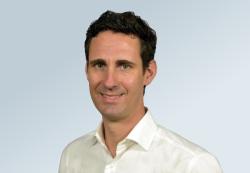
Can you introduce SkyLab and its role in DYN-MARS?
SkyLab is a think tank and research organisation at the interface of flight operations, flight research and flight testing. In DYN-MARS, we brought our operational and engineering expertise, contributing to the high-level requirements, concept definition, system architecture, functional testing, and the scenarios used in the operational tests with evaluation pilots.
Technical solutions only succeed if they fit into an operational context and that welcomes novel approaches because it makes life easier for pilots and controllers.
If a solution improves operational efficiency, cuts fuel burn and reduces noise and eases workload all at once, it makes it far more likely to reach certification and deployment.
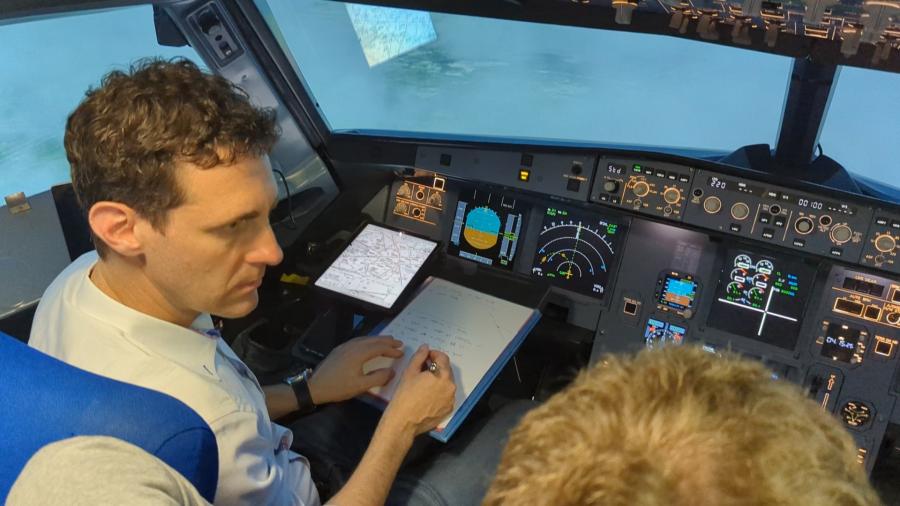
Could you walk us through the pilot setup?
DYN-MARS aimed to improve vertical flight efficiency during descent and approach in complex airspace where the route and speed profile can't be fully predefined from top-of-descent to touchdown.
We tested three connected elements:
- a better policy for issuing speed reductions,
- earlier information about the likely lateral path and shortcuts from the published arrival route, and - most importantly –
- a new flight management system (FMS) function that recomputes an energy-efficient vertical profile after the crew dials in a tactical speed instruction, while the aircraft stays in its automated descent mode.
What stood out in the feedback from the trial participants?
Pilots highlighted the realism of the scenario design and the significant reduction in workload, while controllers continued to work largely as they do today, even as the aircraft’s descents became far more efficient.
One pilot asked: “If I only have to dial in the speed and the aircraft takes care of the entire energy management process, what else is there for me to do?”
It’s a fair question. DYN-MARS enables automated descent in a complex, non-deterministic ATM environment so the role of the human supervisor needs closer consideration.
At the same time, there’s strong statistical evidence of problems with aircraft energy management and unstabilised approaches, meaning the solution addresses safety as well as efficiency.
What gives you most confidence that DYN-MARS has real potential?
The solution is highly modular: each element could be deployed individually, although the greatest benefits come when they all work together.
The controller speed reductions policy for example could be implemented immediately. We also know that some of the more technical elements work in practice, since pilots already use informal workarounds that echo them, such as using the secondary flight plan to estimate shortcuts on the downwind leg. This is essentially a precursor to our expected route-shortcut uplink solution (CPDLC EXPECT).
Is there anything or anyone who deserve a special mention?
Everyone on the project deserves a shout-out. The dedication across the team and pilot participants was remarkable. Special mentions go to researchers Patrick Thöne and Marie Goetz from DLR, research pilot Andreas Winhard, who developed the multi-step test scenarios and Flurin Schwerzmann, who worked meticulously on the solution architecture drawings.
Are there any open questions or issues that need to be addressed next?
The main concern by trial participants was the readability of certain display cues.
Although the system significantly reduces workload, pilots still need to actively monitor the aircraft's energy state relative to the remaining flight distance.
Making the solution cues easier to read and validating it more broadly across airports, weather and weight conditions, is the crucial next step. DYN-MAX, a new SESAR JU project is starting shortly and in it SkyLab will lead the solution for CPDLC use in descent and approach.
How would you describe DYN-MARS’s impact in a single sentence?
The DYN-MARS solution is the first to enable near-optimal descents in a complex, non-predefined tactical air traffic environment.
More about DYN-MARS
DYN-MARS is supported by the SESAR Joint Undertaking within the framework of the Horizon Europe research and innovation programme.