Low-fidelity simulation – testing the concept
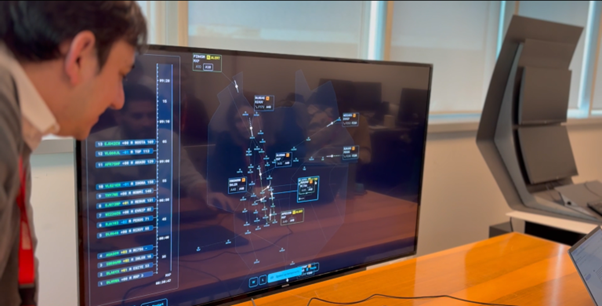
Last November, the TADA consortium conducted an important milestone: a low-fidelity simulation (LFS) at the premises of partner ENAV at Rome ACC.
A low-fidelity simulation is an early-stage experimental setup used to test concepts before investing in high-fidelity or operational environments. It allows researchers and operational experts to explore system behaviour, human interaction and procedural implications in a controlled setting.
The objective of the TADA LFS was to better understand:
- how TADA-supported arrival management performs in realistic traffic scenarios
- how controllers interact with enhanced decision-support tools
- how the proposed concept affects sequencing strategies and workload
- what procedural adjustments may be required for future implementation
The simulation environment replicated inbound traffic to a busy airport configuration. Rather than focusing only on system performance, the exercise used a human-in-the-loop approach.
Five air traffic controllers managed arrival flows under different scenarios, comparing baseline operational practices with situations where TADA-enabled functionalities were introduced.
This approach is essential. TADA is not about replacing expertise with automation, but about supporting controllers with better tools. Observing how users interact with new technologies helps ensure that future solutions reflect real operational needs.
Throughout the sessions, qualitative feedback and operational observations were collected to assess usability, operational feasibility and overall concept robustness.
Key takeaways
The simulation provided valuable early insights into the TADA concept.
First, it confirmed that enhanced decision-support mechanisms can positively influence arrival sequencing strategies.
Second, the exercise highlighted the importance of interface design and information presentation. Even powerful tools must remain intuitive and aligned with controller workflows. The simulation helped identify areas where clarity, timing of information and integration with existing practices can be further improved.
Third, the results reinforced a key principle of TADA: technological innovation must go hand in hand with operational acceptability. Feedback from controllers ensures that future development remains grounded in real operational needs.
Finally, the LFS demonstrated the value of early-stage simulations. By validating assumptions, identifying improvement areas and aligning stakeholders, TADA is progressively moving from concept towards practical implementation.
Looking ahead
The low-fidelity simulation marks an important learning step rather than the final goal. Insights from the exercise will now feed into further development and future testing activities.
As TADA progresses, the project remains focused on delivering solutions that improve arrival management performance while keeping human expertise at the centre of operations.
The future of air traffic management will depend not only on smarter systems, but also on effective collaboration between people and technology.
Follow TADA on LinkedIn to stay updated on project developments and broader news on air traffic management and digital technologies in aviation.
More about the project
