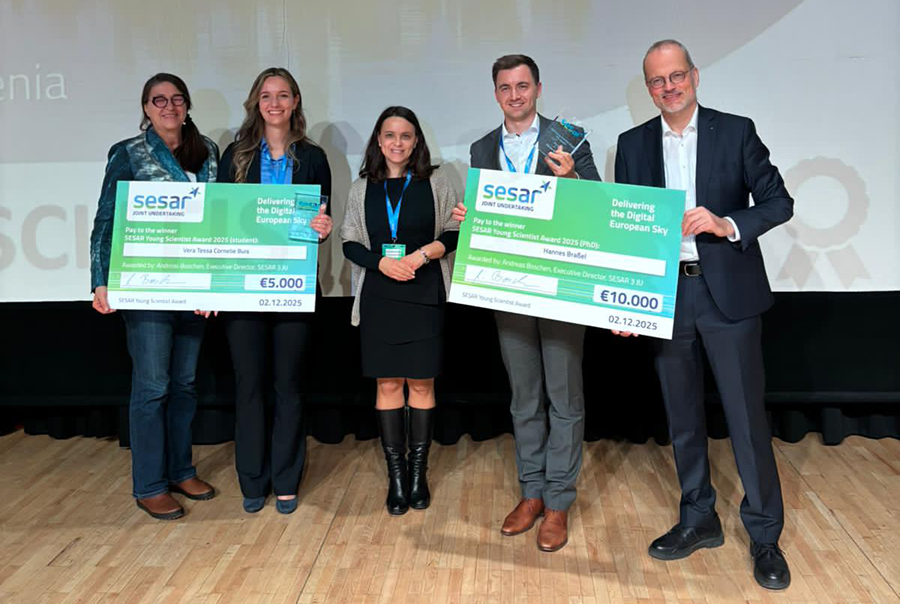
Shaping safer, smarter skies: winners of the 2025 SESAR Young Scientist Award announced
Curiosity, creativity, and a drive to make flying even safer and more sustainable — that’s what unites the winners of this year’s SESAR Young Scientist Award, whose research is helping shape the future of air traffic management and aviation. The winners were announced during a ceremony during SESAR Innovation Days in Slovenia.
The annual award, organised by the SESAR Joint Undertaking, recognises outstanding early-career researchers in two categories – PhD and student – whose work combines scientific excellence with practical relevance to the future of ATM and aviation. Winners gain visibility across Europe’s research community and opportunities for collaboration with SESAR projects and partners — opening doors for the next generation of innovators shaping the future of air traffic management.
The awards were presented on 2 December during the SESAR Innovation Days, the flagship event for ATM research and innovation. Presided over by Andreas Boschen, Executive Director of the SESAR Joint Undertaking, and Violeta Bulc, former European Commissioner for Transport, the ceremony celebrated the next generation of aviation researchers making a tangible impact on the future of ATM.
“These awards recognise young scientists who bring fresh thinking, creativity and excellence to our field,” said Andreas Boschen. “Through their research, they help us turn ambitious ideas into tangible innovations that strengthen Europe’s leadership in air traffic management.”
“The youth is our hope and our future. It’s inspiring to see the dedication and ingenuity of young researchers shaping on the wings of boldness and innovation aviation’s next chapter,” added Violeta Bulc. “Their work reflects Europe’s commitment to sustainable, cross-generational collaboration in building a safer, greener and more connected sky.”
In the PhD category, first place went to Hannes Braßel, Technische Universität Dresden for research on enhancing ground safety at airports, with a solution scalable to airports anywhere and future vertiport environments. The jury praised the work for being “scientifically excellent, embedding the research within the existing framework and advancing it through innovative developments.” The research combines LiDAR technology, computer vision, and prediction algorithms for aircraft and vehicle movements. A key innovation is a simulation environment that generates high-fidelity synthetic LiDAR data, including accurate poses and point labels, across different weather conditions. This avoids the need for real-world data and manual annotation, and can be adapted to any airport by updating the background elements
Coming in second place was Abolfazl Simorgh, Universidad Carlos III de Madrid, for a thesis on climate-friendly trajectory optimisation, addressing non-CO₂ effects in flight planning. The jury noted that the work is of high relevance to air traffic management, offering solutions for structured and free-route airspace operations.
Third place went to Lidia Serrano Mira, Universidad Politécnica de Madrid, for work on dynamic separation in air traffic management, developing flexible approaches to manage aircraft spacing in en-route and terminal areas. The jury described the research as “exceedingly relevant to air traffic management” and praised its innovative exploration of variable separation minima.
In the student category, the top place was awarded to Vera Tessa Cornelie Buis, Wageningen University & Research in collaboration with LVNL, for applying machine learning algorithms to improve airport visibility forecasting, especially in low-visibility conditions. The jury found the thesis to include very “innovative features” and the methodology to be “very thorough”, exceeding expectations. Accurate is short-term weather forecasts, especially for low-visibility conditions, are critical for airport efficiency, as poor forecasts can reduce runway capacity by up to 67% and limit effective flow and capacity management. This thesis shows that machine learning models, particularly a probabilistic temporal fusion transformer with a custom focal loss function, can reliably predict low-visibility conditions, outperforming traditional numerical weather models.
Dagh Zeppenfeld, German Aerospace Center (DLR) was awarded second place for research using machine learning to predicting aircraft clearance reaction and execution times in en-route operations, which the jury described as “relevant to the field of air traffic management” and demonstrating “a very good level of innovation.”
Finally, third place was awarded to Tex Matthijs Ruskamp, Technische Universiteit Delft in collaboration with LVNL for work on take-off time (TOT) predictability, analysing data patterns to improve departure management. According to the jury, the work is “highly relevant to achieve an adequate demand-capacity balance” and applies real data effectively to advance operational predictability.
As this year’s ceremony demonstrated, the future of European air traffic management is in good hands – hands that are curious, creative, and committed to making aviation smarter, safer, and more sustainable.
Read about past winners of the prize
Read about the 2025 edition of SESAR Innovation Days